
Product
Product
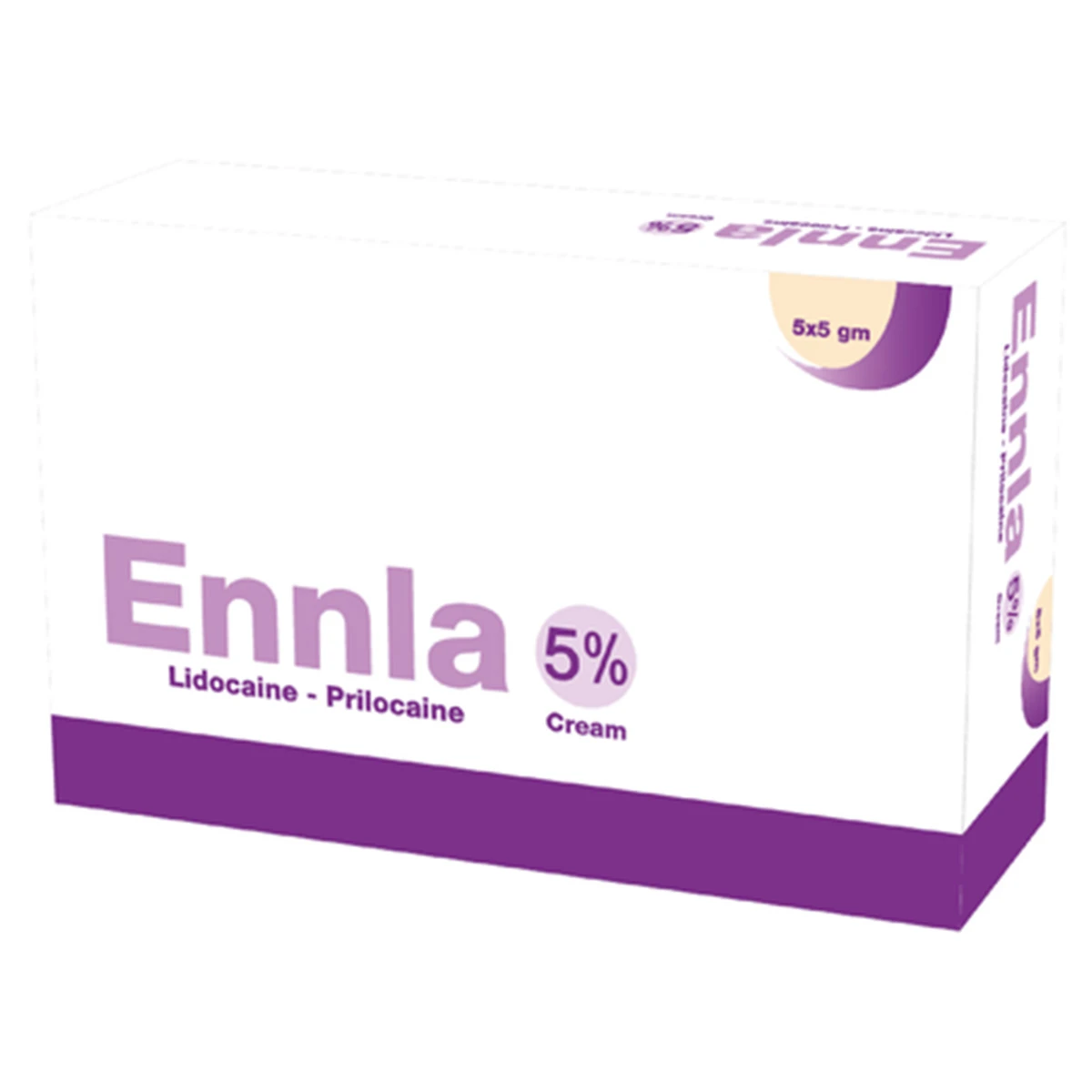
Lidocaine & prilocaine belong to groups of medicines called common local anesthetic Ennla cream is applied to: Intact skin prior to minor dermatological procedures (e.g. needle insertion and surgical treatment of localised lesions) and prior to dermal procedures on larger areas e.g. split skin grafting. Dermal procedures on newly shaven skin of large body areas e.g. laser hair removal. Topical anaesthesia of the genital mucosa, e.g. prior to superficial surgical procedures or prior to infiltration anaesthesia of mucosa. Topical anaesthesia of leg ulcers to facilitate mechanical cleansing/de- bridement. How to use How to use Ennla cream: Adults: A thick layer of Ennla cream is applied on the skin and covered it with occlusive dressing. Children: Apply a thick layer of Ennla cream with occlusive dressing for 30- 60 minutes. Warnings and precautions Do not take Ennla cream if: You are allergic (hypersensitive) to Ennla or any of the other ingredients in Ennla cream. If you are not sure, talk to your doctor or pharmacist before using Ennla cream. Take special care with Ennla cream: Check with your doctor or pharmacist before using Ennla cream if: You have a history of local hypersensitivity to Ennla or to any of the excipients in the preparation. Your baby is pre-term neonate i.e. gestational age less than 37 weeks. You have abnormal haemoglobin in the blood. You are defective glucose-6-phosphate dehydrogenase. You have any of the following risk factors that increases systemic effects such as: Injured skin, opened wounds, or genital mucosa. Impaired tympanic membrane in the ear. Application to a large surface area or for long period. Atopic dermatitis Anemia If direct contact to the eye, since cataract and glaucoma might result. You have infected skin, since infection might spread. If you are not sure if the above apply to you, talk to your doctor or pharmacist before using Ennla cream. Side Effects Like all medicines, Ennla cream can cause side effects, although not everybody gets them. Allergic reactions: Stop the treatment and see the doctor straight away if your skin gets worse or becomes swollen. Other side effects include: Very common (affects more than 1 in 10 people). None. Common (affects more than 1 in 100 people and less than 1 in 10 people) Transient local reactions at the application site such as paleness, erythema (redness) and swelling caused by fluid. An initial and usually mild sensation of burning, itching or warmth at the application site. Storage Information Store below 30° C. To be used within one month after first opening. Do not freeze. Drug Interactions Please tell your doctor or pharmacist if you are taking or have recently taken any other medicines. This includes medicines that you buy without a prescription and herbal medicines. This is because Ennla cream can affect the way some medicines work. Also some other medicines can affect the way Ennla cream works. In particular, tell your doctor,pharmacist if you are taking any of the following medicines: sulphonamides, acetanilid, aniline dyes, benzocaine, chloroquine, dapsone, metoclopramide, naphthalene, nitrates and nitrites, nitrofurantoin, nitroglycerin, nitroprusside, pamaquine, para-aminosalicylic acid, phenacetin, phenobarbital, phenytoin, primaquine, quinine. other local anaesthetics or agents. anti-arrhythmic drugs class III (eg, amiodarone). cimetidine or betablockers. Ingredients Active ingredients: Lidocaine 2.5% w/w Prilocaine 2.5% w/w Non-active ingredients: Carbomer, EDTA, Sodium hydroxide, Cremophores, Cetostearyl alcohol and purified water. Specifications White to off white homogenous smooth cream in collapsible aluminium tubes of size 5, 15 or 30 gm.
We are Sorry, this product is unavailable now, explore other products.