
Product
Product
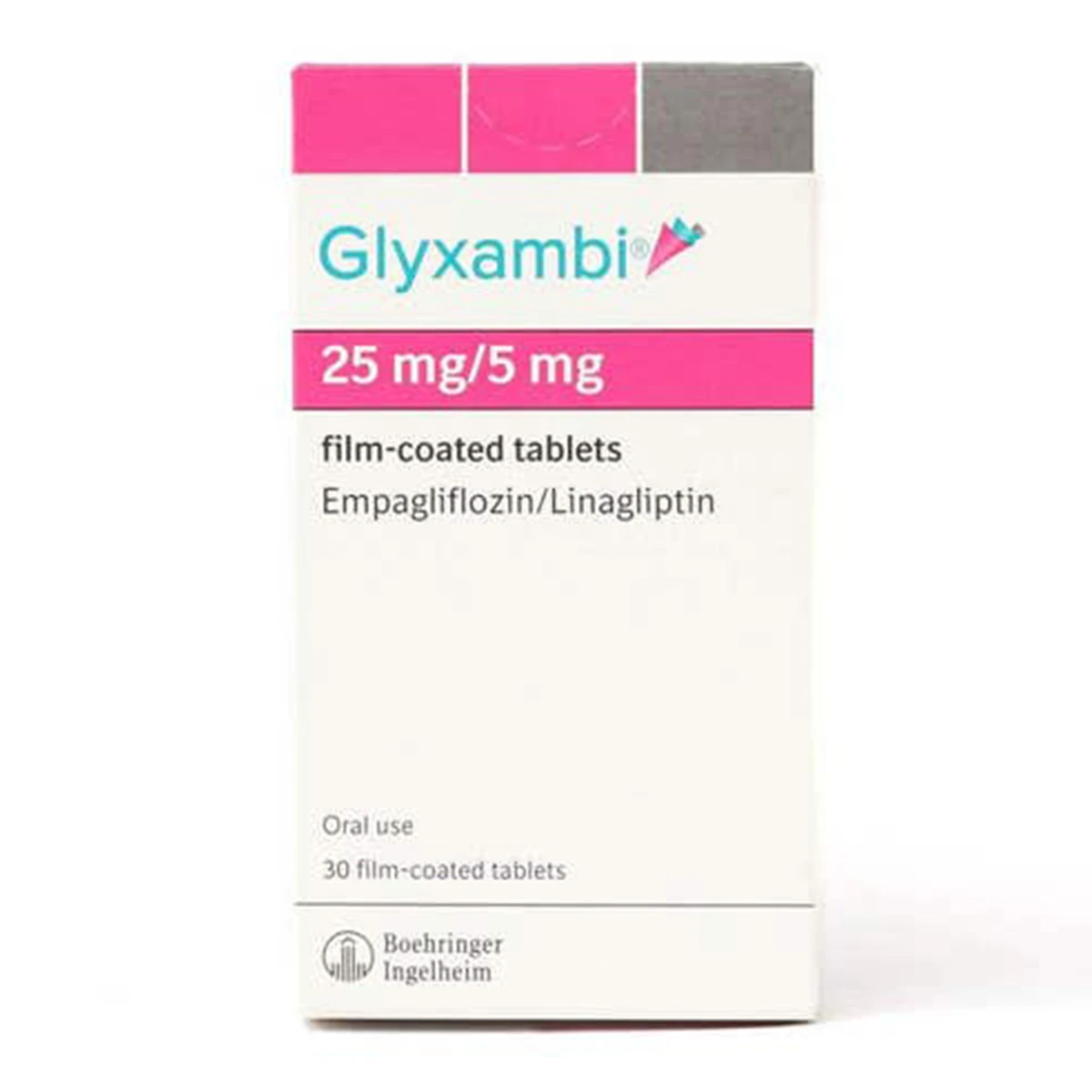
Glyxambi contains two active substances called empagliflozin and linagliptin. Each belongs to a group of medicines called “oral anti-diabetics”. These are medicines taken by mouth to treat type 2 diabetes. Empagliflozin belongs to a group of medicines called sodium glucose co-transporter-2 (SGLT2) inhibitors. It works by blocking the SGLT2 protein in your kidneys. This causes blood sugar (glucose) to be removed in your urine. Linagliptin works in a different way, namely by enabling the pancreas to produce more insulin to lower blood glucose levels. It does this by blocking a protein called DPP-4. Thereby Glyxambi lowers the amount of sugar in your blood. Glyxambi is added to metformin and/or sulphonylurea (SU) to treat type 2 diabetes in adult patients aged 18 years and older whose diabetes cannot be controlled when treated with metformin and/or sulphonylurea in combination with empagliflozin, or when treated with metformin and/or sulphonylurea in combination with linagliptin. How to use How much to take The usual starting dose is one film-coated tablet of Glyxambi 10 mg/5 mg (10 mg empagliflozin and 5 mg linagliptin) once a day. Your doctor will decide whether you need to increase your dose to one film-coated tablet of Glyxambi 25 mg/5 mg (25 mg empagliflozin and 5 mg linagliptin) once a day. If you already take 25 mg empagliflozin and 5 mg linagliptin as separate tablets and you switch to Glyxambi, you can start directly with Glyxambi 25 mg/5 mg. Warnings and precautions Do not take Glyxambi If you are allergic to empagliflozin, linagliptin, any other SGLT2 inhibitor (e.g. dapagliflozin, canagliflozin), any other DPP-4 inhibitor (e.g. sitagliptin, vildagliptin), or any of the other ingredients of this medicine. Warnings and precautions Talk to your doctor, before taking this medicine, and during treatment: If you have type 1 diabetes (your body does not produce any insulin). Glyxambi should not be used to treat type 1 diabetes. If you experience rapid weight loss, feeling sick or being sick, stomach pain, excessive thirst, fast and deep breathing, confusion, unusual sleepiness or tiredness, a sweet smell to your breath, a sweet or metallic taste in your mouth, or a different odour to your urine or sweat. Contact a doctor or the nearest hospital straight away as these symptoms could be a sign of “diabetic ketoacidosis” – a rare, but serious, sometimes life-threatening problem you can get with diabetes because of increased levels of “ketone bodies” in your urine or blood, seen in tests. If you are taking other anti-diabetic medicines known as “sulphonylurea” (e.g. glimepiride, glipizide) and/or using insulin. Your doctor may want to reduce your dose of these medicines when you take them together with Glyxambi, in order to avoid too low blood sugar (hypoglycaemia). If you have or have had a disease of the pancreas. If you have serious kidney problems. Your doctor may limit your daily dose or ask you to take a different medicine If you have serious liver problems. Side Effects Contact your doctor immediately if you notice any of the following side effects: Allergic reactions, seen uncommonly (may affect up to 1 in 100 people) This medicine may cause allergic reactions, which may be serious, including hives (urticaria) and swelling of the face, lips, tongue, and throat that may cause difficulty in breathing or swallowing (angioedema). Other side effects while taking Glyxambi: Seen commonly Genital yeast infection like thrush Inflamed nose or throat (nasopharyngitis) Cough Passing more urine than usual or needing to pass urine more often Itching Skin rash Increased blood enzyme amylase Increased pancreas enzyme lipase Thirst Constipation Storage Information Store below 30°C Drug Interactions In particular, you should tell your doctor if you are using the following medicines: Other anti-diabetic medicines, such as insulin or a sulphonylurea. Your doctor may want to lower the dose of these other medicines, to prevent your blood sugar levels from getting too low. Medicines used to remove water from your body (diuretics). Your doctor may ask you to stop taking Glyxambi. Medicines that might have an effect on the break down of empagliflozin or linagliptin in your body such as rifampicin (an antibiotic used to treat tuberculosis) or certain medicines used to treat seizures (such as carbamazepine, phenobarbital or phenytoin). The effect of Glyxambi may be reduced. Lithium because Glyxambi can lower the amount of lithium in your blood. Ingredients The active substances are empagliflozin and linagliptin. Each film-coated tablet contains 25 mg empagliflozin and 5 mg linagliptin. The other ingredients are: Tablet core: mannitol (E421), pre-gelatinised starch (maize), maize starch, copovidone, crospovidone, talc and magnesium stearate. Film coating: hypromellose, mannitol (E421), talc, titanium dioxide (E171), macrogol 6000 and iron oxide red (E172). Specifications Glyxambi 25 mg/5 mg film-coated tablets (tablets) are pale pink, arc triangular, flat faced and bevel- edged. They have “25/5” on one side and the Boehringer Ingelheim logo on the other side. Each side of the tablet is 8 mm long.
We are Sorry, this product is unavailable now, explore other products.